
Related Posts



CFA for Investment Banking: Is It Actually Worth It?
Almost everyone exploring a career in investment banking runs into the same question: “Should I do CFA?” On paper, the connection seems obvious. The CFA curriculum builds a strong foundation in areas such as valuation, financial analysis and corporate finance, all of which are relevant to investment banking. But that does not make CFA a direct route into the industry.
Investment banking hiring also depends heavily on financial modelling, relevant experience and access to the right opportunities. So instead of simply asking “Is CFA useful for investment banking?”, the better question is:
“What do investment banks actually look for, where does CFA add value, and what can it not replace?” That is what this guide breaks down.
What Does an Investment Banker Actually Do?
To understand whether CFA helps, first look at what the job requires.
Investment bankers advise companies on raising capital and executing major transactions such as mergers, acquisitions and IPOs. Behind those deals, though, is a lot of groundwork.
At the analyst and associate level, that often means evaluating companies, building financial models, preparing valuations and pitch books, supporting due diligence and updating transaction materials as a deal progresses.The job demands more than knowing finance concepts. You need to be able to analyse a business, value it, work through the numbers in Excel and turn that analysis into something a client can use.
That gives us a much better benchmark for judging CFA: how closely does it match the skills investment banks are actually hiring for?
What Gets You Hired?
This is where the CFA question becomes much easier to answer.
We asked our students which investment banks they would most like to work for. Names such as Goldman Sachs, JPMorgan, Morgan Stanley, Citi, Barclays, UBS, Lazard and Evercore came up repeatedly. That gave us a useful place to start. During our research in August 2026, we reviewed Associate-level roles across these eight firms to understand what they were looking for in candidates.
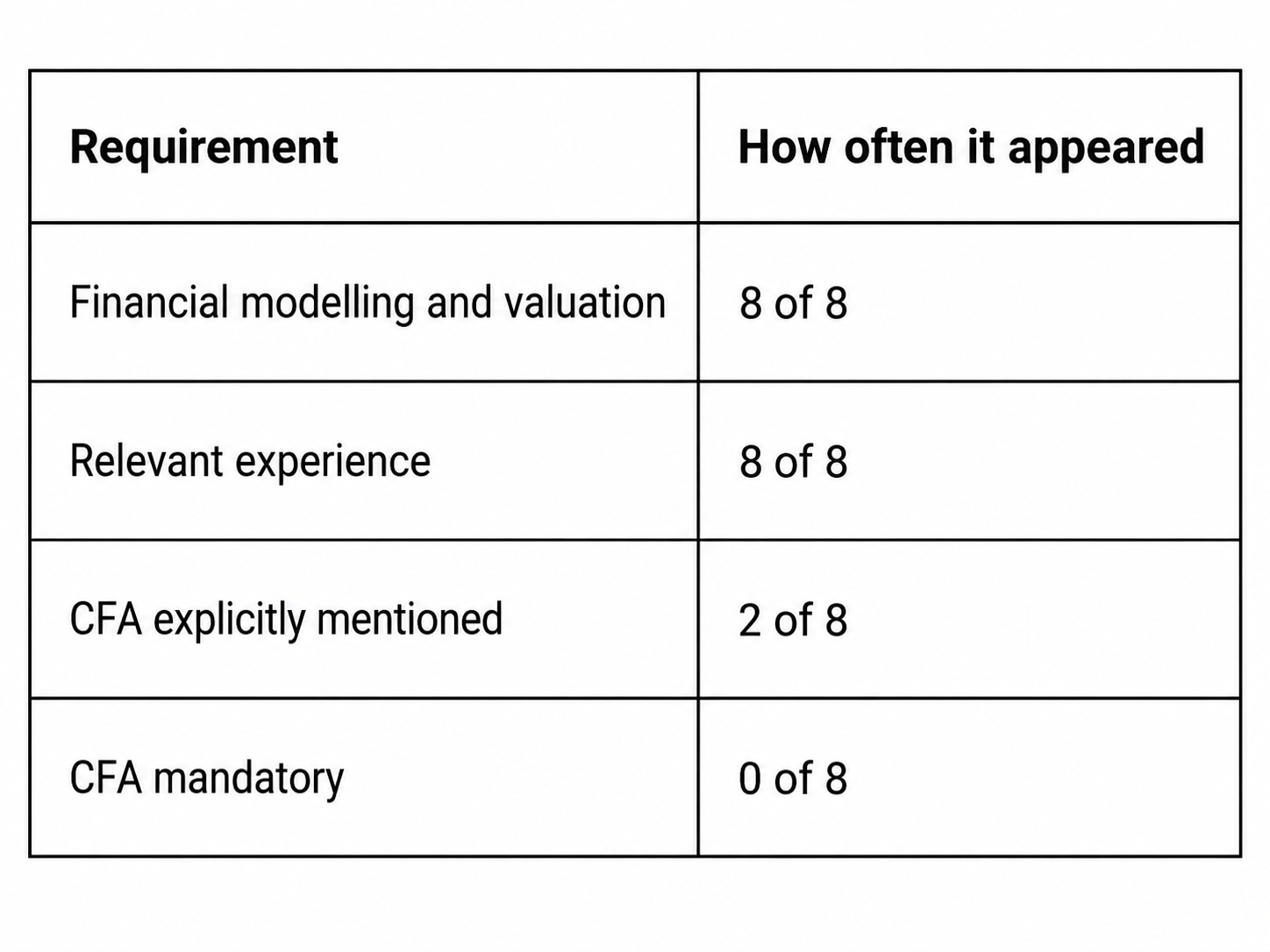
The job descriptions were not identical, but the priorities were remarkably similar. Financial modelling, valuation, transaction analysis and relevant investment banking or M&A experience appeared consistently.
CFA was explicitly mentioned in only 2 of the 8 roles. Morgan Stanley described it as an asset, while Lazard listed it as one possible indicator of quantitative ability. Now, this is a small snapshot of the market, and hiring requirements can change across firms, teams and roles. But the pattern still gives us a useful indication of what banks tend to prioritise.
They appear to place the greatest weight on whether you can do the work the role demands. CFA can strengthen your profile, but it does not replace modelling ability or relevant experience.
Which brings us to the next question: if CFA is not usually the deciding requirement, where does it genuinely add value?The easiest way to judge whether CFA should be your priority is to identify what your profile is missing.
If finance concepts still feel weak, your gap is Foundation. If you understand valuation but cannot build models confidently, it is Execution. If you have the skills but little relevant work on your CV, it is Experience. And if you have all three but struggle to get interviews, the gap is Access.
Your next step should follow that gap: build stronger finance knowledge, strengthen your financial modelling skills through an applied program such as Analyst Stack, gain transaction-related experience or improve your access to relevant opportunities. CFA is most useful when Foundation is the problem.
If you are unsure whether your gap is knowledge, modelling, experience or access, our Skill Match Advisor can help you assess where your profile currently stands.
CFA vs MBA for Investment Banking
The Access gap raises another common question: should you choose CFA or an MBA for investment banking? They are often compared as competing qualifications, but they usually solve different problems.
CFA is more useful when you need stronger finance knowledge, especially in valuation, financial analysis and corporate finance. A strong MBA can be more valuable when you need structured recruitment, a stronger alumni network or a clearer route into a new industry.

This also does not have to be an either-or decision. Some candidates may build their finance foundation through CFA first and consider an MBA later if access or career switching becomes the bigger challenge. The better choice depends on the gap you are trying to solve, not on which qualification looks stronger on paper.
What Does the Investment Banking Route Look Like in India?
In India, the route into investment banking is often very different depending on where you start.
For students at leading MBA campuses in India, investment banking opportunities can come through a fairly structured recruitment process. Banks and financial institutions hire for internships and full-time roles directly from these campuses. But most students do not enter investment banking this way.
If you are from a non-target college, or are already working in another finance role, the path is usually more gradual. You may first build experience in valuation, transaction advisory, corporate development, or a boutique investment bank, and then move closer to larger investment banking roles. This is also where the Access gap matters.
CFA can strengthen your finance knowledge and make your profile more credible, especially if your academic background is not finance-heavy. But it does not create the recruiting access that a target campus or relevant deal experience can provide. For many candidates in India, CFA works best as one part of the journey, not as the route itself.
What If You Are Not From a Target Campus?
If you are not coming through a structured campus route, your starting profile matters much more.
- If you are a CA: you may already have strong accounting knowledge, so the bigger gap could be valuation, modelling or transaction exposure. In that case, CFA may add less value than direct deal experience.
- If you come from a non-finance background: CFA can help you build the finance foundation you may be missing before you move into more practical deal-related work.
- If you already work in valuation, corporate development or transaction-related finance: you may be closer than you think. Your next challenge may be building stronger deal exposure or improving access to investment banking roles.
The important point is that there is no single non-target route. CFA can be useful, but only if it solves the gap your profile actually has. The goal is not to collect more credentials. It is to keep moving your profile closer to the work you want to do.
What Does the CFA Data in India Tell Us?
CFA can add career value, but the numbers need to be read carefully. CFA Institute's 2023 India impact assessment, conducted with Kantar, surveyed 2,154 respondents. It reported average annual compensation of around ₹9.8 lakh for new Level I candidates and ₹28.6 lakh for recently awarded charterholders.
There is an important context behind that difference. Recently awarded charterholders in the study also had around six years of work experience on average, so the higher compensation cannot be credited to CFA alone. The study also found that 66% of respondents felt the CFA Program had a high impact on career progression, while 51% reported a tangible impact on compensation growth.
These are encouraging numbers, but they are finance-wide figures, not investment banking salary data. For a student considering CFA specifically for investment banking, that distinction matters. The qualification can add value to your career, but whether it is the right next step depends on what you need from it.That is ultimately where CFA fits in investment banking: as a useful addition to the right profile, not a requirement for every profile.
FAQS
1. Is CFA useful for investment banking?
Yes. It helps build knowledge in valuation, financial analysis and corporate finance, all of which are relevant to investment banking.
2. CFA or MBA: which is better for investment banking?
CFA is better for finance knowledge, while an MBA can offer stronger recruiting access, networking and career-switching opportunities.
3. Can CFA help you get into investment banking from a non-target college?
It can strengthen your profile, but internships, networking and relevant experience still matter significantly.
4. Should a CA pursue CFA for investment banking?
It depends on the gap in your profile. For many CAs, modelling skills or transaction exposure may be a higher priority.
5. Does CFA help in investment banking interviews?
It can help with valuation and finance concepts, but interviews also test practical skills, deal understanding and technical ability.
Behind every article is the SSEI Team, bringing together educators, finance professionals, and content specialists to make finance easier to understand.
View All Articles